
Newsletter January 2026








Infrastructure Southeastern Europe
Romania, Greece and Bulgaria get bridges over Danube via Black Sea – Aegean transport axis
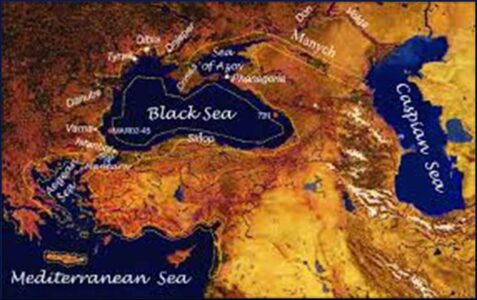 The governments of Romania, Greece and Bulgaria signed a Memorandum of Understanding on cross-border cooperation within the Black Sea and Aegean Corridor Platform on Wednesday, Dec. 3, in Brussels. The document provides for the acceleration of road, rail and marine infrastructure projects connecting the two seas through the territories of the three states. The law was signed by Bulgaria’s Deputy Prime Minister and Minister of Transport Grozdan Karadjov, Greece’s Deputy Minister of Transport Konstantinos Kiranakis and Romania’s Secretary of State for Transport Ionuț Cristian Săvoiu. The initiative is supported by the European Commission, through Transport and Tourism Commissioner Apostolos Zidzikostas, who announced the creation of a European Commission working group for technical and financial support. The document includes objectives related to common infrastructure, especially in the Danube sector. Bulgaria proposed the construction of three new bridges over the Danube: an additional bridge at Ruse-Giurgiu, a bridge at Silistra-Călărași and a bridge at Nikopol-Turnu Măgurele. Modernizations of the Oryahovo-Bechet, Sviștov-Zimnicea and Silistra-Călărași ferry routes are also planned, so that they can be used for both civilian transport and military mobility, according to European standards.Thus, three transport axes between the Aegean Sea and the Black Sea. The memorandum’s action plan defines the modernization of road and rail links in three main directions: Western axis Athens – Sofia – Vidin/Calafat – Bucharest – Central Europe. Central axis Thessaloniki – Alexandroupolis – Svilengrad – Ruse – Bucharest, with extension to Ukraine and the Republic of Moldova.
  Eastern axis Alexandroupolis – Boergas – Varna – Constanta, a route directly connecting the ports of the Aegean Sea with those of the Black Sea. The three states agreed to use European financial instruments under the Connecting Europe Facility (CEF) in the current and future Multiannual Financial Framework 2028-2034. Funding will be coordinated to avoid duplication and ensure efficient allocation of resources. In addition to European funds, public-private partnerships and other financial instruments from the European institutions will also be used. Logistics implications for Romania For Romania, the projects included in the MoU focus on: – increasing connectivity capacity with Bulgaria through modernized bridges and transport routes; – integrating the port of Constanta into the new regional logistics flows; – improving road and rail connections with Greece; – increasing the interoperability of military transport infrastructure, in the context of EU and NATO commitments.
How high does Constanta rank among European ports?
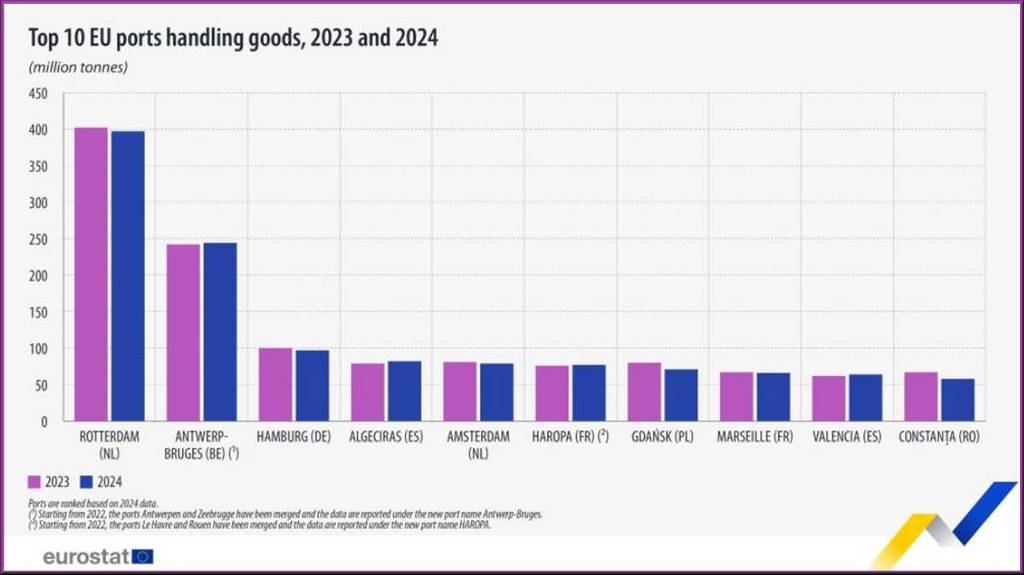 Romania climbed to 10th place last year among the top European countries based on the amount of goods handled in ports, after still being 13th in 2023, Eurostat data show. This officially makes Constanța the 10th largest port in the European Union (EU).
In 2024, EU seaports handled about 3.4 billion tons of cargo (gross weight). Although this cargo volume was the same as in 2023, it remained below the highest value recorded in the period 2014-2024 (3.6 billion tons in 2019).
Rotterdam in the Netherlands retained its position as the EU’s leading seaport, with 397 million tons of cargo by 2024. Antwerp-Bruges in Belgium followed with 244 million tons, followed by Hamburg in Germany with 97 million tons. 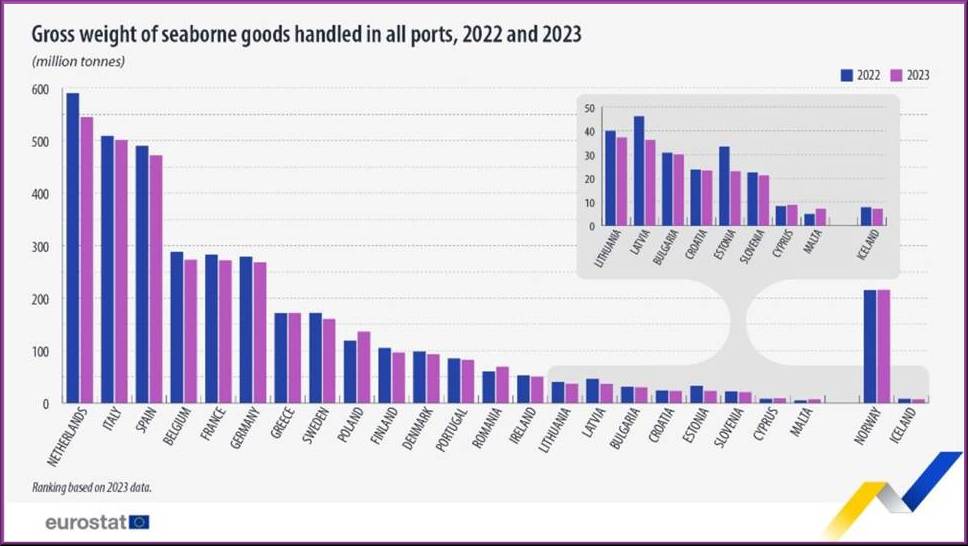
Of the top 10 EU ports, four reported an increase in tons of cargo handled in 2024 compared to the previous year. Valencia (+3.6%) and Algeciras (+2.6%) in Spain recorded the largest increases. On the other hand, Constanța in Romania (-14.3%) and Gdańsk in Poland (-11.0%) reported the largest decreases.
In comparison, Eurostat data shows that in 2023, Romania ranked 13th among European countries in terms of the volume of cargo in ports.
This information comes from data on maritime freight transport recently published by Eurostat. This article presents some conclusions from the more detailed Statistics Explained article on maritime freight transport.
U.S. President Donald Trump has officially invited Romanian President Nicusor Dan
 US President Donald Trump has officially invited Romanian President Nicusor Dan to visit the US in the coming months. This was announced by presidential adviser Cristian Diaconescu during an appearance on a Romanian television channel, IPN reported.
“There is an official invitation from President Donald Trump to President Nicusor Dan. The two had a very good bilateral conversation about a month ago,” Cristian Diaconescu said. He added that the meeting should take place as soon as possible.
At the same time, Romanian Foreign Minister Oana Toiu announced her previous visit to the United States with stops in New York and Washington. The purpose of that visit was to prepare for the bilateral meeting between Romanian President Nicusor Dan and U.S. President Donald Trump
Artificial and business Intelligence (AI and BI)) is at the bottom of the global rankings in Romania vlg PwC Workforce and Mazars Romania
Artificial and business Intelligence (AI and BI)) in Romania vlg PwC Workforce and Mazars Romania is at the bottom of the world rankings in terms of implementing artificial intelligence (AI) in the workplace, according to the PwC Workforce Hopes and Fears Survey 2025 report. Only 44% of Romanian employees surveyed reported having used AI tools in the past year, significantly lower than the 57% average of the 48 countries analyzed.

On the other side are emerging markets where technology is developing rapidly: India and Vietnam have a usage rate of 84% and China as high as 78%. Romania ranks 41st out of 48 in this area, leaving behind only a few mature economies such as Japan and Hungary, where acceptance drops below 40%.
“AI has great potential to increase productivity and creativity, but many workers are reluctant to use it. The reluctance is mainly due to the fact that implementation is often fragmented and there is a lack of training tailored to the skills of each category of employees. In other words, some see AI as an addition to existing processes, with no real value,” said Ruxandra Târlescu, Coordinating Partner Tax, Legal&People, PwC Romania.
She emphasizes that to fully exploit the potential of AI and accelerate progress, companies need a coherent technology integration strategy, systematic and equitable training programs and clear communication. The question can also be asked whether there is an unwanted slavishness to “algorithms. Algorithms iteration and Aerastart point are concrete use cases and the ability for employees to test AI tools themselves – especially in non-management functions, where trust and acceptance rates are currently lower.
At the upcoming Romanian Business Day, Harry Heijes will update you on the Acceleration and Aftermath of Ai.
 The use of AI (in Romania) varies significantly by hierarchical level and generation: from 64% of senior executives and 59% of managers who have used artificial intelligence in the workplace in the past 12 months, to only 35% of non-managers. Based on demographic criteria, 57% of Generation Z employees use AI, compared to 44% of millennials and 35% of Generation X.
The daily use of AI technologies among Romanian workers is also one of the lowest among the countries analyzed: about 6% of all workers use AI-generated tools daily (the global average is 14%) and only about 2% use AI agents daily (compared to 6% globally).
 According to the PwC report, only a third of Romanian workers are enthusiastic about the impact of AI at work. This is below the global average of 41%. However, nearly half say they are curious and a quarter are concerned. Those who already use the technology report consistent benefits: 75% see an improvement in the quality of work, 69% an increase in creativity and 64% an increase in productivity. In the medium term, more than half expect further increases in these indicators, but only 31% expect AI to give them higher salaries.
However, when it comes to the factors that will have the most impact on their jobs in the coming years, Romanian workers cite other factors: half believe legislative changes will have a major impact on the job, 43% believe in geopolitical conflicts and only 39% believe in technological transformation.
 “Romanian workers were expected to prioritize legislative changes and geopolitical conflicts, as 2025 brought many legislative and fiscal changes that negatively affect companies and implicitly affect the situation of workers. However, there is good news, namely that those who use AI are discovering its benefits and can influence its implementation on a larger scale. However, the future depends on new technologies and employees must adapt to meet the increasing demand of companies for AI skills,” said Oana Munteanu, director of PwC Romania.
The PwC Workforce Hopes and Fears Survey 2025 shows that 60% of employees in Romania declare themselves very optimistic about the future of their role within the company. This is one of the highest percentages among the 48 countries analyzed, while the global average is 53%. 
In addition, 72% of local workers believe they will have at least some control over how technology affects their work, compared with 69% globally.
In contrast, when it comes to the impact of AI on entry-level positions, 41% of Romanian managers who participated in the survey believe AI will reduce the number of such positions within their organizations over the next three years, while only 25% expect an increase.
 In a rapidly changing economic climate and an increasingly competitive business environment, auditors are under increasing pressure to deliver analytics that are relevant, accurate and aligned with current business needs. At the same time, clients are demanding personalized solutions and real-time access to information that supports their strategic decision-making. In this context, digital technologies – particularly Business Intelligence (BI) and Artificial Intelligence (AI) – are becoming increasingly important tools for transforming the way audit engagements are conducted.
Romania is no exception to this trend. According to Forvis Mazars’ C-suite Barometer 2025, 68% of Romanian leaders already have a digital transformation strategy using technology, and 54% are implementing a specific strategy for generative artificial intelligence. These figures reflect a clear awareness of the need to integrate digital solutions into daily operations, including in the audit practice.
ECB President Christine Lagarde announces the impact of artificial intelligence on the euro zone: “It stimulates investment in the economy.”
Christine Lagarde, president of the European Central Bank. L Benefits of the digital euro Monetary policy, “in a good situation” European Central Bank President Christine Lagarde has indicated that the
Algorithms can be addictive and we lose control

Early adoption of BI and AI technologies in auditing practice contributes significantly to increased market competitiveness.
By embracing these technologies, auditing moves beyond its traditional role of simple compliance monitoring and transforms into a continuous process of analysis, monitoring and prevention. AI enables the rapid and accurate processing of large amounts of data, while BI provides intuitive visualization of essential information for management decision-making.
This paradigm shift aligns with IT trends highlighted in the same survey, which shows that 54% of business leaders in Romania consider efficiency and productivity to be the most important goals of digitization.
BI and AI technologies help achieve this goal by automating repetitive tasks, reducing report generation time and improving data processing accuracy.
“Artificial intelligence and BI solutions do not replace auditors, but support them in decision-making and identifying critical risk areas. It is essential to ensure the quality of the data processed and to invest in the continuous training of teams to effectively use these technologies. Modern auditing means a digital culture, flexibility and the ability to anticipate,” said Iulian Condrea, Senior Manager, Audit & Assurance, Forvis Mazars in Romania.
This statement comes at a time when 86% of top executives view artificial intelligence (AI) as an important factor for their business (34% even see it as an “important” factor), and 70% are already using AI in their internal processes, according to the same survey. These figures not only confirm the need to integrate digital technologies into business processes, but also highlight the accelerated pace at which business is adapting to new technological realities.
In this context, auditing is emerging as one of the key pillars where BI and AI solutions can make a tangible impact – not only by streamlining business operations, but also by strengthening customer and stakeholder trust. Digital leadership is therefore becoming critical to guide organizations toward an auditing model adapted to the new technological reality, as intelligent systems evolve from disruptive technologies to strategic tools seamlessly integrated into decision-making and operational processes.
Integrating technology into auditing can be complex and challenging.
While the benefits are clear, implementing digital technologies into auditing practice also brings challenges. According to the report, 44% of C-suite leaders cited limited budgets as the main barrier to digitalization, followed by the complexity of implementation and security and compliance requirements (both cited by 42%).
Auditing presents specific challenges, such as the integration of digital solutions with existing systems, the shortage of specialists with both technical and financial expertise, and the need to educate clients about the benefits of new technologies.
Integrating BI and AI involves not only acquiring sophisticated tools, but also modifying internal processes, redefining workflows and changing the traditional responsibilities of auditors. For many professionals, the transition from traditional methods to digital approaches may evoke resistance due to fears that automation could diminish the human role in the audit process. At the same time, data quality poses a major challenge when using these solutions. Intelligent systems can only deliver accurate and relevant results if the input data is precise, complete and compliant. Without rigorous data management, there is a risk of generating incomplete or inaccurate reports, which can compromise both the audit process and stakeholder confidence. In addition, adapting IT infrastructure to new technologies requires significant investment and careful planning. Many organizations struggle with outdated systems or solutions that are difficult to integrate with BI and AI platforms, which can significantly lengthen the duration of digitization projects and limit expected short-term benefits. Lay a strong foundation for the future of auditing by investing in people and technology In this context, an investment in technology must be accompanied by a strategic investment in human capital. A digital culture within companies is essential, not only for increasing efficiency, but also for attracting the new generation of auditors. Universities play a crucial role in training specialists with the relevant skills to use new technologies. They are responsible not only for sharing theoretical knowledge, but also for integrating digital skills into the curriculum. In an era when technology is the basis for professional activities, academic institutions should actively contribute to preparing students to develop a deep understanding of the impact of emerging technologies on auditing processes. In this way, graduates can be equipped with the necessary tools to effectively integrate these solutions into their daily work. At the same time, continuous learning – through specialized courses, training or collaborations with online learning platforms – is essential to ensure that auditors can quickly adapt to technological developments and the ever-changing demands of the industry.
Business leaders in Romania are confident in the return on investment in digitalization and 76% support the implementation of generative artificial intelligence. In this context, the application of BI and AI solutions in audits is no longer optional, but a necessity to deliver relevant, timely projects that meet ever-changing quality standards and regulations.
At the upcoming Romanian Business Day, AI and its application will be explained in understandable language. The present message is a preparation for the information session.
At an earlier meeting on Sept. 25, 2025 in Bucharest (ZF Hi-Tech Innovation Summit 2025, 7th Edition. AI in 2025: realities versus promises) Eugen Schwab Chesaru, Vice President Central and Eastern Europe of Pierre Audoin summed it up Consultants (PAC):” I don’t see turbulence due to AI, rather I see opportunities. For Romania, artificial intelligence offers companies from all sectors and government agencies the opportunity to accelerate digitalization and technology adoption.”
“In the long term, we expect the market for AI software and IT services to reach 400-500 million euros in 2035, exclusively in Romania. This means that one in ten euros spent on software and IT services in Romania will be for AI and AI-related applications.”
“This year, we expect AI spending by companies and institutions in Romania to reach 50 million euros, exclusively in software and IT services, excluding exports. And by 2028, this amount will reach 120 million euros, or almost 5% of total investments in software and IT services.”
Artificial intelligence offers opportunities for the Romanian economy. According to him, AI will become indispensable for a competitive industry, whether in classic sectors such as defense, energy or utilities, or in modern services – from finance to retail. Romania, he argues, will need to accelerate its digitalization “with AI power” to keep pace with global transformations.
“I see AI as a great opportunity for Romania, but there is a paradox. Many believe that AI can compensate for deficiencies in human intelligence or training. But it doesn’t. To embrace, implement, use and efficiently deploy AI, you need trained people, highly educated and in smaller numbers than before for classic projects. I think that is the biggest problem, because more resources will be needed, more people, more top-level specialists, with the highest education and competencies. And the biggest problem is access to the right people, especially because in a globalized context where we know that talent and resources have access to jobs that transcend borders, they naturally go where it is most profitable,” explained Eugen Schwab Chesaru at the 7th edition of the ZF Hi-Tech Innovation Summit 2025. AI in 2025: reality versus promises.
ECB: Artificial intelligence boosts investment in economy
 European Central Bank President Christine Lagarde has indicated that the eurozone economy is undergoing structural change, driven by investment in artificial intelligence (AI), and assured that decisions on interest rates will only be made on the basis of available data, amid persistently high uncertainties, reports Euronews.
Analysts said one of the most striking messages from the ECB president during Thursday’s press conference was about the central role of AI, given investments by large companies and SMEs. Spending is focused on powerful computers, telecommunications networks and intangible assets such as data and software, rather than traditional investments in physical capital, writes Agerpres.
While Lagarde acknowledged that AI could eventually increase output, she cautioned against premature conclusions about its impact on so-called “neutral monetary policy.”
In an environment characterized by geopolitical shocks, trade fragmentation and high uncertainties, the ECB president argued that such structural parameters are relative and were not discussed by the Governing Council at last Thursday’s meeting.
Digital Euro
Regarding the digital euro, Lagarde announced that the ECB has completed the technical and preparatory work and that responsibility now lies with the political institutions.
The project, which aims to create a public digital currency, is currently being analyzed by the European Council and the European Parliament.
“Our ambition is to ensure that in the digital age there is a currency that acts as an anchor of stability for the financial system. The digital euro is an instrument designed for monetary sovereignty rather than innovation,” the ECB official said.
U.S. Navy buys Damen design for landing craft
U.S. Navy buys Damen’s design for new landing craft for $3.3 mln. Despite lawsuit against Damen, United States pushes through deal for major fleet renewal.
The landing craft LST100 is already in use by the Nigerian Navy.
At the tail end of a difficult year, Damen received a boost from the U.S. Department of Defense. The US Navy bought the design for a new landing craft from the Gorinchem-based shipbuilder. For this, it paid $3.3 mln, according to the US Naval Institute USNI.
With the deal, the Americans do not seem to care about recent lawsuits against the group and three (former) executives. The defendants are ceo Arnout Damen, chief executive officer Kommer Damen and former CEO René Berkvens.
The prosecution suspects the group of bribery and forgery. The three are suspected of taking too little action against the risks of bribery. In a separate case, the prosecution accuses Damen of violating sanctions rules against Russia. Recently, two employees were arrested for a new suspicion of violating sanctions. After questioning, they were released.

South Pacific
The U.S. Navy’s Navsea unit is responsible for procurement of weapon systems. In a fleet renewal program, it chose Damen’s LST100 landing craft design. The Americans want to build 35 of these. The vessel can be used to land marines and equipment in possible military operations, particularly in the Pacific and Asia.

Damen posted a notice about the order on its website last month. In a response, the shipbuilder said it sees the U.S. order as “special and honorable. It is the first time the concern has done business with the U.S. Navy. In the past, it did sell designs to the U.S. Coast Guard. Based on those designs, “more than a hundred ships” have been built, says a spokesman.
Breaking with tradition
By choosing an existing design, the Americans are breaking with a long tradition of using only their own work. The US designers came up with plans that were too expensive, according to a short video in which Secretary of the Navy John Phelan explains the purchase.
The US is looking to renew its landing craft fleet in the near future. According to Phelan, a design with already proven technology was therefore chosen. He does not intend to change much about the design because the landing craft are needed quickly. US Marines have been able to see the vessel’s technology in practice.
The Australian Navy decided to build eight of these ships as early as the end of 2024.
Starting in 2026
According to the news site Defense Industry Europe, construction of the first ships should begin in 2026. From 2029 they should be deployable. They will be built by shipyards in the US. This is laid down in a law.
Whether Damen will have a role in construction is unclear, according to the spokesman. Indeed, it is not yet known which shipyards will be working on it. ‘But if necessary, Damen can of course advise and support, as happens more often in this type of project.’
It happens regularly that customers buy only designs from Damen. Since the 1970s, this has involved more than 1,500 designs, says the spokesman. This kind of deal runs through the Damen Technical Cooperation division.
The Americans seem satisfied with Damen’s 100 landing craft. The Americans want to build 35 of them. The vessel can be used to land Marines and equipment in any military operations, particularly in the Pacific and Asia.
US Marines have been able to see the ship’s technology in action. Already one copy is in use by the Nigerian Navy.
The poultry meat market, the most successful in the food industry
The poultry meat market, the most successful in the food industry, can export from 32 plants. What are the 10 largest producers in terms of capacity?
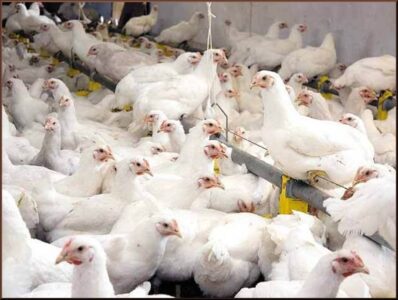 The poultry meat market may be the export champion of the Romanian food industry, with 32 slaughterhouses meeting the highest standards for exporting products, according to data provided by the National Authority for Sanitary, Veterinary and Food Safety (ANSVSA) at ZF’s request.
“The list of companies authorized to trade within the European Union is constantly changing. Currently, there are 32 poultry slaughterhouses,” said Adrian Suru, head of ANSVSA’s communications and documentation logistics department. In addition, Romania has several dozen smaller slaughterhouses exclusively for the domestic market.
In terms of the poultry market, Romania is in a very good position. According to Eurostat data, the country ranks sixth within the European Union, behind traditionally strong countries such as Germany and Italy.
Now the country covers its own consumption, with production growing steadily over the past decade to 550,000 tons by 2024, a 35% increase. The Romanian poultry sector has increased its capacity and captured the domestic market, but at the same time the value of poultry exports has also doubled in a decade. For example, Romania exported poultry meat worth 270 million euros in 2024, compared to 140 million euros 10 years earlier, according to INS data.
Top 10 manufacturers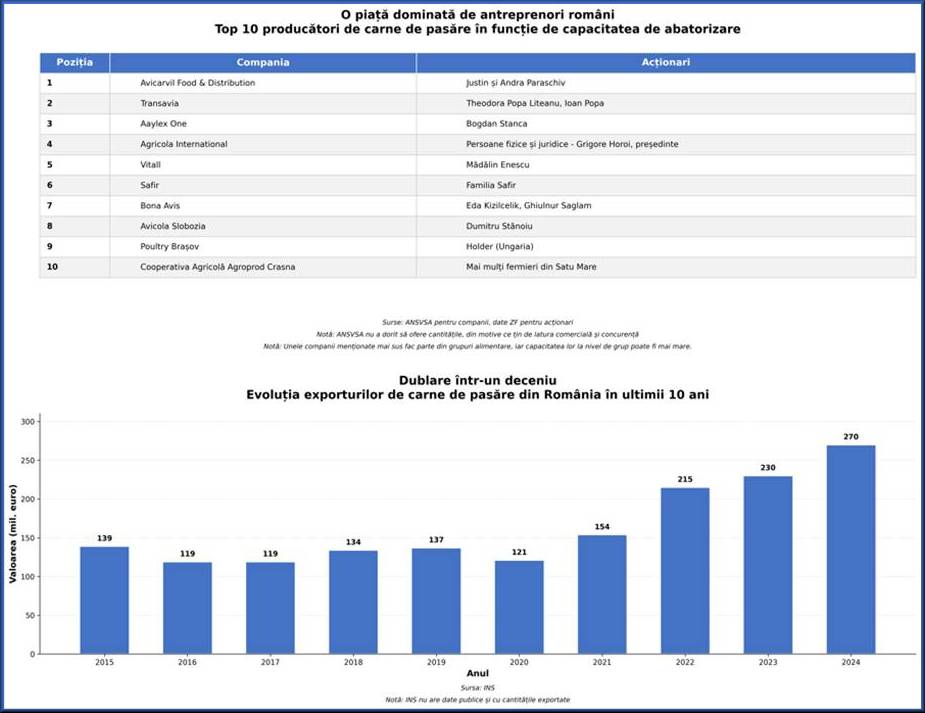
Carmistin has been the new national leader in poultry and animal feed production since 2025 and is consolidating its growth strategy through a major investment program. This year, the group’s poultry capacity reached 120,000 tons and a capacity of 140,000 to 150,000 tons is expected for 2026.
The march to the top position in the poultry meat market followed after the group opened a new plant between the towns of Băbeni and Frânceşti in Vâlcea Province in mid-2025. The total investment was 76 million euros, with an ambitious goal of 100 million chickens slaughtered per year, to be achieved within five years. With this, the group aims to increase its presence in the domestic market under the La Provincia brand, as well as boost exports.
The group realized export sales of 140 million lei of poultry meat in 2024, three times as much as in 2023. For the current year, the company expects a further tripling of sales in foreign markets, to 450 million lei, thanks to the expansion of its international presence and the growing demand for poultry meat produced in Romania. “We already export poultry meat to more than 30 countries,” Justin Paraschiv said this year. The group has 32 poultry farms in southeastern Romania.
According to ANSVSA data, Transavia ranks second. The company recently announced it produced 120,000 tons of chicken meat. So the difference between the first two places is very small, indicating exciting competition. Transavia has the chicken brand Fragedo and the chicken-based semi-finished products Papane in its portfolio. The company is one of the largest employers in Romania, with more than 2,300 employees, mainly working in its 31 poultry farms and four vegetable farms, compound feed plant, three slaughterhouses and meat processing plant. About 30% of the company’s annual production is exported.
In third place among the top poultry meat producers is Aaylex One, whose majority shares are owned by Buzău-based entrepreneur Bogdan Stanca. The company markets products under the Cocorico brand name and exports about 30% of its meat to Romania, according to the latest data from ZF.
Agricola from Bacau is next in line. “Agricola has implemented investment programs in its production capacity, development projects and marketing strategies that have so far totaled more than 250 million euros. This is how we managed to increase production to the maximum potential offered by the facilities we use. In 2024, compared to the volumes in the reference year 2009, we produced and sold 145% more poultry meat, more than doubling,” said Grigore Horoi, president of Agricola, a company worth more than 1.1 billion lei, which also operates in the sausage, egg and ready-to-eat meal markets.
In the top ten largest players in the poultry meat industry, as reported by ANSVSA to ZF, most major companies have Romanian capital and are integrated. Only two companies have foreign investors behind them. These are Bona Avis from Ianca, in Brăila province, owned by Eda Kizilcelik and Ghiulnur Saglam, and Poultry Braşov, an abattoir that is part of the Poultry Investment group, controlled by the Holder group from Hungary.
The poultry market is the most successful in the food industry and is dominated by Romanian entrepreneurs at the top, who have developed integrated businesses. They are role models in the food industry, where the trade balance is skewed toward imports. In 2024, for example, Romania recorded a €5 billion trade deficit in food and live animals. Although most commodity categories have very high imports, poultry is an exception. In this case, Romania is an exporter.
Romania has the lowest consumption of fruits and vegetables in the European Union, despite its great agricultural potential.
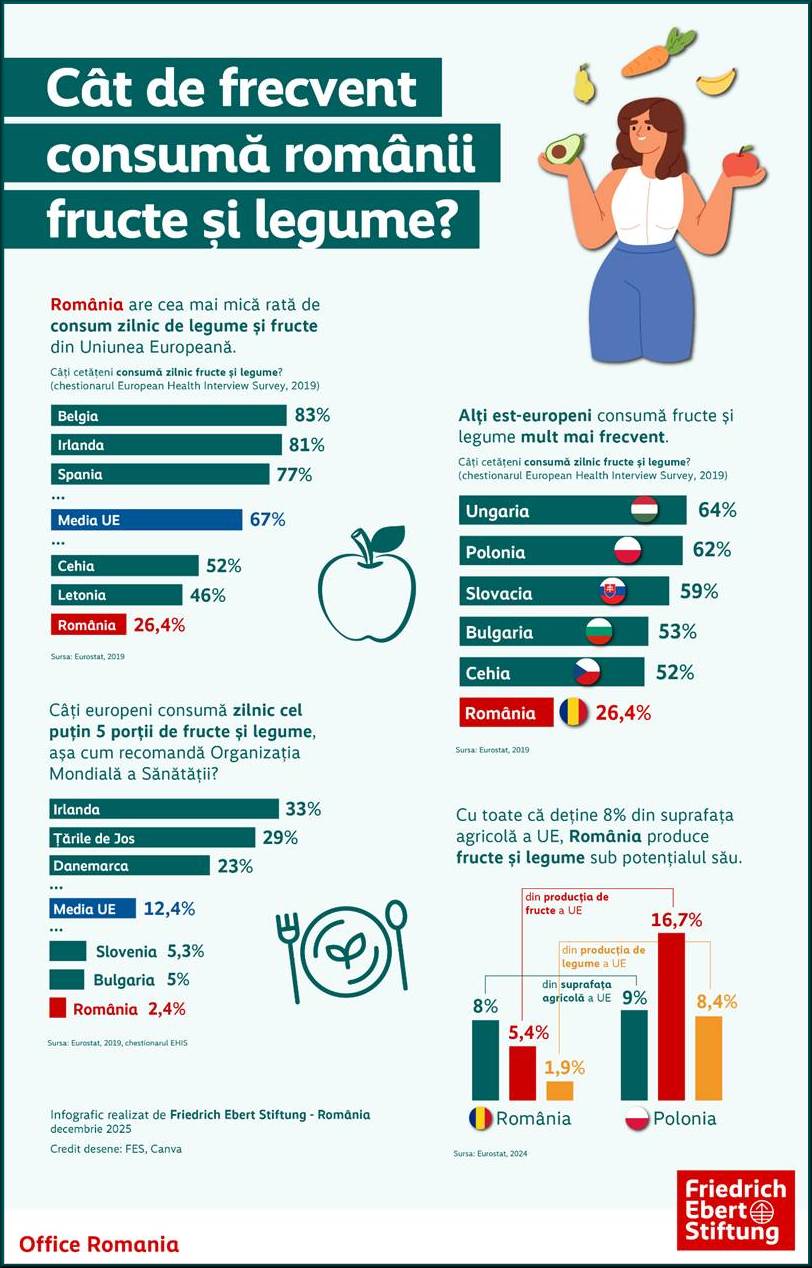 Romania, despite its great agricultural potential, has the lowest consumption of fruits and vegetables in the European Union. Almost 75% of Romanians do not eat a single serving of vegetables or fruits daily, and 24% consume between one and four servings a day. Only 2.4% of Romanians meet the World Health Organization’s recommendation of eating five servings daily, Eurostat data show.
Although Romania owns 8.1% of the agricultural area used in the European Union, it contributes only 1.9% of annual fresh vegetable production and 5.4% of fruit production, while representing only 4.2% of the EU population. This underproduction maintains import dependency and price pressure, which particularly affects low-income consumers.
The EU27 average shows a much better situation: only 33% of Europeans do not eat fruits and vegetables daily, 55% consume between one and four servings and 12% reach the recommendation of five or more servings per day. Even in Central and Eastern Europe, Romania lags behind countries like the Czech Republic, Poland or Bulgaria.
The distribution of agricultural land could allow for significant domestic production. Romania uses 12.8 million hectares of agricultural land, representing 8.1% of the EU27 total of 157 million hectares. However, fruit and vegetable production remains far below this potential. For example, Poland produces 16% of vegetables and 8% of fruits in the EU27, while using only 9% of available arable land.
Low fruit and vegetable consumption has direct public health and economic consequences. An unbalanced diet increases the risk of non-communicable diseases and lowers productivity. The WHO recommends a minimum of 400 grams of fruits and vegetables per day, equivalent to five servings, an amount that very few Romanians achieve.
Romania has the agricultural potential to rapidly reposition its fruit and vegetable market, but this requires coherent public policies, investments and support for low-income consumers. Start at holiday meals: fresh fruits and vegetables on your plate mean health for every Romanian.
The first Chernomorka restaurant in Bucharest
The company Chernomorka SRL was registered in May this year and rented a 280 sq. m. space in Unirea shopping center, in the Splai wing, on the first floor, according to data consulted by Economica.net on the platform Termene.ro .
Shareholders in the company are Inna Lubenska and Denys Shcherbyna, who both own 50% of the shares.
The opening, scheduled for this winter, was announced via social media, along with job openings. The Bucharest restaurant is scheduled to open in February-March 2026.
The restaurant is designed for 98 to 102 seats, said Olga Kopylova, the chain’s owner, quoted by Forbes Ukraine .
Kolylova did not disclose the value of the investment, but indicated that it includes preparation of the premises, purchase of equipment, start-up of operational processes, logistics, staff training and start-up of marketing.
” Bucharest is a large market with a growing gastronomic culture . The general context of the Black Sea and close culinary traditions allow the Ukrainian brand to integrate organically into the local environment,” said the owner of the Chernomorka restaurants.
In 2022, the Ukrainian chain also opened a restaurant in Constanța.
Why the humble burger is becoming a luxury delicacy across Europe.
 What was once a cheap and comfort food is fast becoming a luxury in Europe as beef prices skyrocket due to declining livestock that cannot meet growing demand, according to Euractiv.
Farmers welcome the price increase, but wonder how long it will last. At the other end of the supply chain, café owners are dissatisfied, and that is true across the EU.
Beef consumption has remained stable in Europe in recent years, but the types of products people buy have changed. Demand is increasingly shifting toward minced meat, preferably in the form of a hamburger, a trend that has been called the “burgerization” of taste.
According to Yari Vecchio, researcher at the University of Bologna, consumers today prefer soft, easy-to-chew textures and immediate flavor, and minced meat meets these requirements.
Although beef mince is cheaper, Vecchio explains, processing it into burgers adds value, shifting profits from farmers to processors.
A $15 “gourmet” burger may use cheaper meat than a steak, but the price is still high.
This trend has an uneven effect on overall beef consumption. Although some European consumers are buying less due to food inflation, prices remain high.
In the end, supply remains the biggest problem.
High prices are good news for farmers, but they are unlikely to reverse the long-term decline of the livestock sector.
Farmers also fear cheaper beef imports could wipe out recent gains.
Ilie Bolojan and the Dutch prime minister ate in the canteen, along with soldiers from the Câmpia Turzii air base.
Prime Minister Ilie Bolojan on Tuesday had a conversation with his counterpart from the Kingdom of the Netherlands, Dick Schoof, during a working visit to Air Base 71 “General Emanoil Ionescu” in Câmpia Turzii. The conversation covered support for Ukraine, peace negotiations in Ukraine and the response to hybrid threats and Russia’s disinformation campaigns. The two officials also met with Dutch, Romanian and U.S. military personnel at the base and enjoyed a meal in the canteen. Romanian Prime Minister Ilie Bolojan and Dutch Prime Minister Dick Schoof  paid a working visit to Air Force Base 71 “General Emanoil Ionescu” in Câmpia Turzii, where they met with Romanian and Dutch military personnel stationed at the base. According to the management, the visit provided an opportunity for bilateral consultations on the security situation in the region and NATO cooperation, against the backdrop of the Russian Federation’s war of aggression against Ukraine. “The two prime ministers discussed ongoing measures to strengthen the allied presence on the eastern flank and the concrete contributions of the allied states to deterrence and collective defense. The Kingdom of the Netherlands’ contribution to NATO missions in Romania was highlighted, including the deployment of military drones and Dutch Air Force personnel. Joint projects in the field of training were also discussed, especially the F-16 Pilot Training Center in Borcea,” the government said. The meeting with Dutch, Romanian and U.S. military personnel at the base also provided an opportunity for direct dialogue on missions conducted and operational conditions. “The Romanian prime minister appreciated the professionalism and responsibility with which they perform their duties and emphasized the role of international cooperation in maintaining regional security,” the press release said. The two prime ministers also discussed support for Ukraine and stressed the need for a unified approach at the allied level, within NATO, as well as close cooperation with the United States. Also discussed were issues related to the ongoing peace negotiations in Ukraine, as well as the coordinated response to hybrid threats and Russia’s disinformation campaigns. “The visit confirms the high level of cooperation between Romania and the Kingdom of the Netherlands and the continuity of a partnership adapted to the current security situation, with concrete contributions at allied and regional levels,” the executive said. Along with Romania’s prime minister, the visit was attended by Deputy Prime Minister Radu-Dinel Miruţă, National Defense Minister Mihai Jurca, the head of the prime minister’s chancellery, State Counselor Luminiţa Odobescu, as well as Lieutenant General Dragoş-Dumitru Iacob, Deputy Chief of the Defense Staff.
Romania joins largest EU semiconductor research project
Europe takes a strategic step to become relevant in the semiconductor industry. Romania, through the Polytechnic University, is launching the NanoIC pilot line with several other countries.
 With this, the European Union aims to establish its own commercial production of advanced chips at a time when global competition is dominated by the US and Asia, according to data analyzed NanoIC is designed as a research and testing infrastructure for technologies “beyond classical semiconductors,” where the chip size falls below the 2 nanometer limit. These are technologies that will form the basis for future generations of computers, communication networks, mobility systems, energy and medical applications. The project is part of a broader effort by the European Union to strengthen its technological autonomy, in line with the European Chip Act. The core idea is simple: Europe no longer wants to be just a consumer of advanced technology, but a player that develops and produces itThe heart of the NanoIC project is at Imec in Leuven, Belgium, one of the world’s most advanced microelectronics research facilities. Here, as well as at partner centers in France, Germany, Finland, Ireland and Romania, new types of chips, memories and interconnects will be tested before being used in commercial plants. Romania is part of the consortium through the Politehnica University of Bucharest, which conducts research in the areas of surfaces, materials and nanotechnologies. Romania’s participation in this project places the country in a small group of countries that directly contributes to the development of technologies previously one of its production units was located. Learn more about the important role of Politehnica University in this t u here . In short, NanoIC is a “pilot line” where ideas from the lab are developed into a near-ready product. Highly advanced system-on-chip chips, new generations of memory and interconnection solutions that allow multiple chips to function as one system are being tested. It is an essential step for European companies to turn research into concrete products that are competitive in the global market Digital Europe and Horizon Europe, complemented by contributions from participating countries, including Romania. It is a long-term investment designed to ensure that Europe does not miss the boat in an area that directly affects economic, industrial and even geopolitical security The Republic of Moldova is testing electric power producers. “Legislative area” for unregulated technologies, with ad hoc exemptions from applicable standards. In the short term, NanoIC is a research project. In the medium and long term, it is a strategic move: if Europe succeeds in turning these technologies into commercial products, it will have an important voice in an industry that powers everything from cell phones and data centers to electric cars and advanced medical devices.
AI needs data, qualitative clues and … context.
Cognizant will build a team of 1,000 Context Engineers, the engineers who make artificial intelligence even smarter.
As artificial intelligence (AI) makes the transition from the “laboratory” to the real business world, it is becoming increasingly clear that it takes more than just data to function. There is no AI without quality data, but data alone does not tell the whole story. What makes data meaningful is a combination of trust, talent and, most importantly, context. AI really needs to understand how businesses work.
Context is what turns numbers into models, moving AI from a pilot project to an actual implementation and making data actionable. This is where context engineers come in – specialists who make sure AI systems understand a company’s workflows, data and decision-making processes that make each organization unique. With their help, AI becomes even smarter, faster and better aligned with business goals.
Cognizant invests in Context Engineers
 But the future is not about “data versus context.” It’s about data in context, and that seems to be the key to scaling AI. Cognizant has announced a strategic initiative to build and deploy a team of 1,000 context engineers over the next year , a crucial step toward developing “agentic” AI that actually works in the real world.
This decision represents a major investment in an emerging discipline: context engineering, essential for AI agents to reason and act coherently, in line with an organization’s goals. As part of this initiative, Cognizant is partnering with Workfabric AI, the company developing the “context engine” for AI in enterprises.
Cognizant’s 1,000 context engineers will work with Workfabric AI’s ContextFabric™ platform, a technology that transforms a company’s organizational DNA (how teams work, workflows, data, rules and processes) into actionable context for AI agents. By acting as a continuous operational layer that captures organizational context and ensures that agents remain aligned with real-world processes and execution patterns, ContextFabric enables the industrialization of context engineering at scale.
. Context shows how people collaborate using different tools, how they use data in decision-making, how they deal with constraints to overcome challenges – foreseeable or unexpected – and how they ensure compliance with rules to achieve desired outcomes.
Most importantly, context reflects the collective wisdom of an organization. This network of intelligence, present in content, data, applications, workflows and other systems, is the fuel that enables AI agents to accurately, efficiently and dynamically optimize processes and collaboration between humans and AI. Context engineering is an emerging discipline that combines the science and art of delivering the right context, at the right time, to agent-based systems.
Bucharest, Cluj-Napoca, Iași, Timișoara and Baia Mare, and more than 2,500 employees. It is one of Cognizant’s largest software development centers in Eastern Europe. In 2024, Cognizant Romania ranked second in the “Randstad Romania Employer Brand Research 2024,” the most comprehensive employer brand survey in the world. The software development center in Romania is therefore one of the largest Cognizant hubs in Eastern Europe.
*Press release supplied and reproduced by CLS Media
Dayseaday presents two construction projects
Urk – Dayseaday, Urk’s largest family-run fish company led by brothers Jelle and Henk van Veen, is starting two concurrent new construction projects to grow substantially. On the Vliestroom industrial estate, Dayseaday Production’s existing production site will be expanded: in addition to the current 1,000 m² building, a new 2,000 m² building will be constructed with office and storage space above, more than tripling the production floor. Demolition of the former building on the corner of Vliestroom/Stortemelk is now in preparation; construction should start in February.
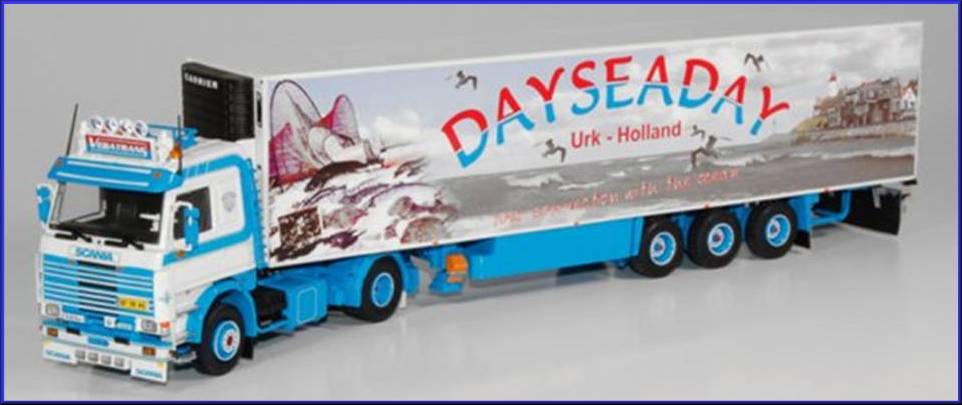
At the same time, Dayseaday has submitted sketches to the municipality for a plot purchase of 20,000 m² in the new Port of Urk industrial park. The plan is to build a double coldstore there with a total of about 10,000 pallet spaces: one for Dayseaday Frozen and one for subsidiary Bonesca. Design agency BTEC drew the plans. One bottleneck remains the power supply; with the drawings, the company wants to show the municipality and grid operator Liander that the expansion is urgent. As Jelle van Veen sums it up, “We are struggling with a lack of space and therefore want to build as quickly as possible.” The company is also preparing for business succession: the second generation is already taking over management duties, and eight children of the two brothers work in the family business.
Late 2025, ever better for the Romanian economy.
 The European Commission today, Dec. 30, transferred over 586 million euros to accounts at the National Bank of Romania. This money is intended to finance infrastructure projects in the transport sector, Finance Minister Alexandru Nazare announced in a post on Facebook.
The amounts were applied for through the Transport Program 2021-2027, from the Cohesion Fund and the European Regional Development Fund, under Article 93(2) of Regulation (EU) No. 1060/2021.
” Very important: this money does not come from Romanian taxes and fees. They are European funds that go directly into the Romanian economy and are direct investments in infrastructure, regional development and public services,” Alexandru Nazare said.
According to Nazare, the amounts come from expenditures made primarily through the PNRR by beneficiaries in the transportation sector, for major infrastructure projects – such as the Ploieşti-Buzău-Focşani highway, as well as other investments.
On Monday, local governments disbursed about 714 million lei to the treasury under Title 60 – PNRR grants, for investments they made with European money in the areas of urban mobility, energy efficiency and other investments useful to communities.
“New sources of optimism thanks to high public investment and better use of European funds: 2026 will be a better year for the Romanian economy,” the finance minister said.
Romanian stock market, one of the best performing in Europe by 2025
2025 was one of the best years in recent history for the Romanian stock market. The Bucharest stock market stood out head and shoulders above the rest, even in a year when European stock markets generally performed well. But even though Romania was among the champions of the European capital market, this performance did little to change the international perception of the Romanian stock market. The BET, the main index of the Bucharest Stock Exchange, closed 2025 at 24,438.89 points, a new historic high. This level is 46.16% higher than the last trading value of 2024. It is the largest annual increase in the past 15 years and is all the more impressive because it took place in a fragile macroeconomic environment.
 The last time the Bucharest stock market soared was in 2009, the year of recovery from the global financial crisis, or in the early 2000s, when the stock market was small, immature and extremely volatile. Created with Flourish – Create a chart The BET index, however, tells only part of the story. There is another indicator, less known to the general public, that reflects much more accurately what is happening in the market. That’s the BET-TR, the index that accumulates both price increases and dividend payments to investors. In 2025, this index rose 55.21%. Bucharest is among the top European stock markets. From a pure performance perspective, the Romanian stock market is one of the surprises of the year at the European level. The BET index rose more than the main indices of the region’s largest markets, such as Poland and Austria, but also more than those of the major European markets – the United Kingdom, Germany and France. The 46.16% increase places the BET index in fourth place in Europe. The best performer was the Prague stock market index, which rose more than 52%. This was followed by the main index of the stock market in the Slovenian capital, with a value increase of almost 50%. Completing the podium is the IBEX 35, the main index of the Madrid Stock Exchange, which rose 49% last year, helped by the good performance of the Spanish economy. BET follows, and right behind it come the indices of the Vienna and Warsaw markets, which rose 45%. By comparison, major European equity markets performed much worse. For example, the FTSE 100 index of the London Stock Exchange rose 25%, the German DAX index rose 23% and the Paris CAC 40 index fell less than 11%. The reasons why BVB is unsuccessful internationally Although BET broadcasts programs that can easily compete with those of the largest markets, its visibility beyond its borders is weak. Created with Flourish – Create a chart One possible explanation is the size of the market. Even after a spectacular 2025, the total market capitalization of the BVB is 538 billion lei, or 105.5 billion euros. That’s a lot compared to before, but little in a regional context. In Warsaw, the market capitalization is 578 billion euros, with the Polish market being a regional point of attraction for international capital. Prague, although much smaller in terms of the number of listed companies, manages to achieve a market capitalization similar to that of Bucharest, thanks to a few very large issuers that are well integrated into international capital flows. Another explanation has to do with liquidity. At the Bucharest Stock Exchange, the average daily transaction value was 13.4 million euros. Granted, there are better days, but they are not enough for large investment funds. In Warsaw, daily liquidity is measured in hundreds of millions of euros. Even Prague, a concentrated market, offers a more predictable trading volume precisely because turnover is dominated by a few extremely liquid stocks. This explains why a nearly 50% increase in the BET index does not automatically generate international interest. For large mutual funds, returns are relevant only if they can be replicated on a large scale. In Romania, large investments are difficult to make and likewise difficult to liquidate.

This is because the market is concentrated on a few large companies, particularly in the energy and financial sectors, while the rest of the “investment universe” is fragmented and poorly traded. In addition to these structural problems, market classification also plays a role. Romania is still in a gray area, if we look at the classification used by the world’s major equity index providers. In 2020, it was promoted to secondary emerging market by FTSE Russell. A step forward, but one that did not fundamentally change the market. And that’s because MSCI, which classifies us as an advanced frontier market, remains the dominant benchmark in the world of global investment. If granted emerging market status, the Bucharest Stock Exchange would be eligible for funds that track MSCI Emerging Markets indices and manage assets worth trillions of dollars. Unlike BVB, the Warsaw Stock Exchange is considered an emerging market by both MSCI and FTSE Russell, which automatically includes it in the global indices tracked by major funds. At the same time, the Prague stock exchange, although small and concentrated, is also considered an emerging market by MSCI and benefits from a visibility that Bucharest does not have. Therefore, the Romanian capital market no longer faces a yield problem. However, there is a structure problem. MSCI rates markets based on consistent liquidity, sufficient free float, market depth and the ability of the market to absorb large investments without disruption. Bucharest, however, remains vulnerable in many of these areas. Liquidity is concentrated in a few stocks, free float is limited to a few large issuers and large, market-changing IPOs are still rare. Promotion to the top division is expected by all players. But without a steady increase in liquidity, expanding free float and a few large-scale IPOs, rapid promotion remains unlikely. Until this changes, the Bucharest market will continue to do what it already does very well: grow quickly, discreetly and almost without an audience.
Save the date

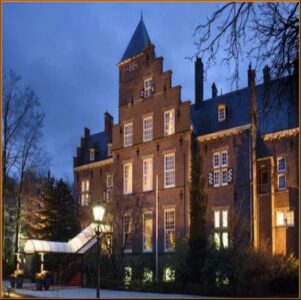
Kasteel de Wittenburg | Wassenaar
We are pleased to let you know that this year’s Romanian Business Day will be held on Thursday, March 12, 2026, in the atmospheric ambiance of Kasteel de Wittenburg in Wassenaar.
Please mark this date in your calendar because the Romanian Business Day promises to be another day with a strong substantive program and plenty of networking opportunities.The full program and further details will follow shortly.
We look forward to seeing you on Thursday, March 12.
Disclaimer

The Dutch Romanian Network newsletter is compiled with great care. The Dutch Romanian Network cannot accept any liability for a possible inaccuracy and/or incompleteness of the information provided herein, nor can any rights be derived from the content of the newsletter. Articles do not necessarily reflect the views of the board.
All images and photos are taken from Pixabay, so are royalty-free.

